
Best robata grill restaurants Dubai: Zuma wins for a broader Japanese dinner. Compare ROKA and a skyline-view Nikkei alternative by cuisine, setting and occasion.
Best overall: Zuma; best for a contemporary robatayaki-focused dinner: ROKA; best for skyline-view Nikkei dining instead of a confirmed robata specialist: Nazcaa. This 2026 guide separates restaurants built around Japanese grill cooking from a Japanese-Peruvian alternative, so you can choose for the food, not just the view.
TL;DR- For best robata grill restaurants Dubai searches, start with Zuma and ROKA, both established Japanese grill destinations.
- Choose Zuma for a broader Japanese restaurant experience in DIFC, with robata as part of the meal.
- Choose ROKA for contemporary Japanese robatayaki dining at The Opus in Business Bay.
- Nazcaa suits skyline-view Nikkei dining on Level 12 of Address Dubai Mall; do not assume a robata offering.
Why this matters
A Japanese restaurant is not automatically a robata restaurant. Sushi, sashimi, teppanyaki and robatayaki describe different preparations, and a dramatic dining room tells you little about what happens over the grill.
Robatayaki centres on cooking over charcoal. The appeal is direct: heat, smoke and the contrast between a browned exterior and the ingredient beneath it. Sauces and garnishes matter, but the cooking method should remain the reason you order.
For your 2026 shortlist, decide whether charcoal cooking is essential or simply one part of the evening. That distinction separates a grill-led dinner from a skyline dinner with Japanese influences. Both can be the right choice; they answer different requests.
If robata is non-negotiable, choose a restaurant explicitly associated with robatayaki before choosing a table for its view.
What makes the best robata grill restaurant?
Use these criteria before comparing restaurants. They keep the ranking tied to the meal you actually want.
- Grill identity: Robatayaki should be an identifiable part of the restaurant’s cooking, not an assumption based on Japanese branding.
- Menu fit: Look for grilled preparations that interest your table. A famous restaurant is not useful if the dishes you want sit elsewhere on its menu.
- Dining format: Decide whether you want the grill to lead the meal or sit alongside raw dishes and other preparations.
- Location: DIFC, Business Bay and Downtown Dubai are distinct settings. Choose the destination that fits the rest of your evening.
- Occasion fit: A food-first dinner, a mixed-preference group and a skyline-led celebration need different recommendations.
- Clear boundaries: A credible shortlist explains what each restaurant is best for and what it does not establish.
There is no reason to treat every criterion equally. If charcoal cooking is your priority, grill identity comes first. If your evening revolves around a landmark view, acknowledge that you are making a different choice rather than calling every Japanese restaurant a robata specialist.
Dubai robata restaurants at a glance
This 2026 comparison ranks by dining purpose, not by an unsupported score. The final entry is an alternative for readers whose occasion matters more than a particular grill technique.
| Restaurant | Best for | Standout feature | Key limitation |
|---|---|---|---|
| Zuma | A broader Japanese dinner with robata | Established Japanese dining in DIFC with a robata component | Robata shares attention with the wider menu |
| ROKA | A contemporary robatayaki-focused evening | Contemporary Japanese robatayaki at The Opus, Business Bay | Does not answer a request specifically for Address Dubai Mall dining |
| Nazcaa | Skyline-view Nikkei dining | Japanese-Peruvian fine dining on Level 12 of Address Dubai Mall | Not established here as a robata specialist |
The useful comparison is not simply which restaurant sounds most impressive. It is which restaurant gives your evening its intended centre: a broad Japanese meal, robatayaki, or Nikkei dining above Downtown Dubai.
1. Zuma: best robata restaurant for a broader Japanese dinner
Zuma in DIFC is the default choice when you want robata within a broader Japanese restaurant experience. Its restaurant concept brings together a main kitchen, sushi counter and robata grill, making charcoal cooking one part of a larger meal.
That breadth is the reason to choose it. Your table does not need to agree that every course should come from the grill; you can make robata central without restricting the entire evening to one preparation style.
Zuma pros
- Robata is an established part of the restaurant’s identity.
- The wider Japanese format suits a table with different preferences.
- The DIFC location gives you a clear destination when planning the evening.
Zuma cons
- The restaurant is broader than a dedicated robata-only experience.
- A meal centred on sushi or other dishes will not answer a grill-first brief.
- DIFC is not the same location as Downtown Dubai or Business Bay.
Best for: Diners who want charcoal-grilled dishes within a varied Japanese dinner.
Before choosing Zuma, decide whether you want the grill to anchor the meal or simply contribute to it. That decision should shape your ordering questions, especially when other diners are more interested in raw preparations.
Ask which current dishes come from the robata grill rather than assuming every cooked Japanese dish does. The restaurant name gets you onto the shortlist; the preparations you select determine whether the meal delivers what you came for.
Verdict: Buy — choose Zuma as the default for a broad Japanese dinner with robata.
2. ROKA: best robata restaurant for contemporary robatayaki
ROKA at The Opus in Business Bay puts contemporary Japanese robatayaki at the centre of its identity. Choose it when the answer to “what are we going out for?” is the grill itself rather than Japanese dining in general.
This is the clearest use-case distinction from Zuma. ROKA gives a robatayaki-led brief a direct starting point, while Zuma suits a wider Japanese dinner in which robata shares the stage.
ROKA pros
- Robatayaki is explicit in the restaurant’s identity.
- The contemporary Japanese format matches a grill-led dining brief.
- The Opus location makes the Business Bay setting clear before you plan transport.
ROKA cons
- Business Bay does not fulfil a request specifically for dining at Address Dubai Mall.
- A robatayaki identity does not establish that every dish uses charcoal cooking.
- It answers a Japanese grill brief, not a Japanese-Peruvian one.
Best for: Diners who want contemporary robatayaki to define the evening.
Choose ROKA by its cooking focus, then check the current menu against your table’s preferences. If someone avoids raw food, do not assume the whole menu is grilled; if someone wants a particular ingredient, ask about that ingredient directly.
For a 2026 dinner, a precise question is more useful than a generic request for recommendations: which dishes best express the robata cooking? That gives the restaurant a clear brief without committing you to an unsupported online dish list.
Verdict: Buy — choose ROKA when contemporary robatayaki is the main reason to go.
3. Nazcaa: best Nikkei alternative for skyline-view dining
Nazcaa is a Japanese-Peruvian fine dining restaurant and bar on Level 12 of Address Dubai Mall. Its place in this guide is deliberately different: it answers a skyline-view Nikkei brief, not a confirmed robata-specialist brief.
Japanese precision. Peruvian character. Downtown Dubai beneath you. Choose this direction when the setting and the meeting of cuisines matter more than a specific charcoal-grilling method.
Nikkei alternative pros
- Japanese-Peruvian cuisine offers a different direction from a Japanese-only dinner.
- The Level 12 setting suits a skyline-led occasion.
- Cocktails and private event hosting are part of the stated offering.
Nikkei alternative cons
- A robata grill offering is not established by the restaurant description.
- Nikkei cuisine and robatayaki are not interchangeable terms.
- A skyline setting does not establish a specific table position or sightline.
Best for: Diners choosing a Downtown Dubai occasion around Nikkei cuisine and skyline views.
Nazcaa is best for skyline-view Nikkei dining in Downtown Dubai, not for a confirmed robata-specialist experience. That boundary matters: a useful recommendation should tell you when to choose a restaurant and when your original requirement points elsewhere.
If charcoal cooking is essential, choose one of the robatayaki options above. If your brief is Japanese-Peruvian fine dining, cocktails and an elevated Downtown setting, this is the relevant alternative to investigate.
Verdict: Hold for a robata-only brief; Buy for skyline-view Nikkei dining.
How to choose without confusing cuisine and cooking method
Start with the part of the evening you would be disappointed to miss. Then choose the restaurant around it, rather than building a justification after falling for a photograph.
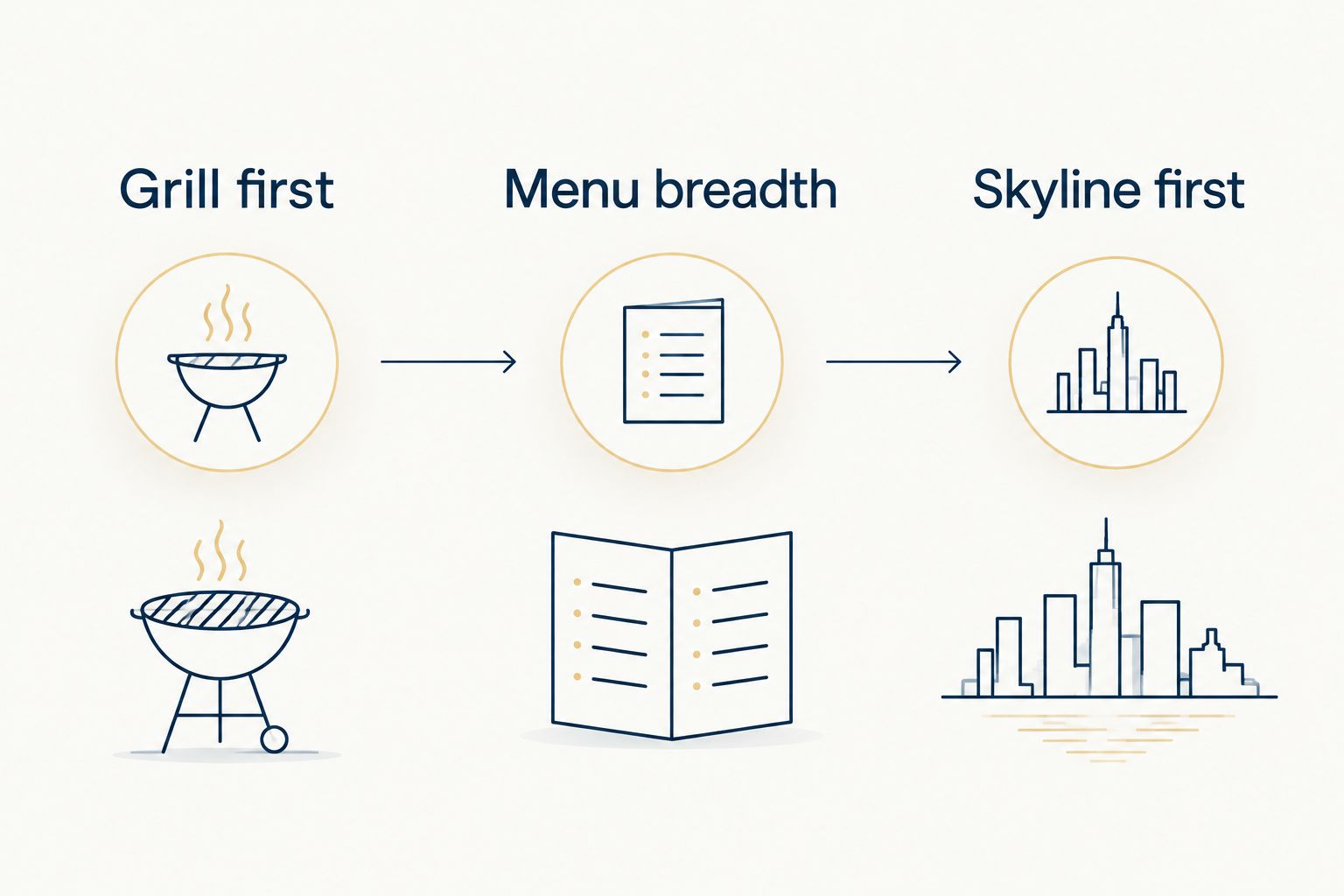
- Grill first: Choose ROKA when contemporary robatayaki defines the meal.
- Menu breadth: Choose Zuma when your table wants robata within a wider Japanese dinner.
- Skyline first: Choose the Nikkei alternative when Downtown views and Japanese-Peruvian dining define the occasion.
These are different priorities, not levels of quality. A restaurant can fit one brief closely and miss another entirely.
Once you have chosen that priority, ask about the current menu and the dining arrangements that matter to you. Do not treat a restaurant’s location as confirmation of your table’s view, or its cuisine label as confirmation of a cooking method.
Ask these questions before making your choice
- Which dishes use the robata grill? This separates the cooking method from the general cuisine description.
- Which preparations suit the whole table? State dietary restrictions and ingredient preferences directly.
- What seating matches the occasion? Explain whether your priority is the setting, conversation or proximity to the cooking.
For a group dinner, circulate the restaurant choice with its reason attached. “Contemporary robatayaki in Business Bay” is more useful than “a Japanese place”; “skyline-view Nikkei dining” sets a different, equally clear expectation.
How the restaurants were ranked
This shortlist uses restaurant identity, cuisine, location and occasion fit. It is an editorial comparison, not a scored tasting test or a claim that every current dish has been assessed.
Zuma takes the overall slot because the brief includes a broader Japanese dinner with robata. ROKA takes the more specific contemporary robatayaki slot. The Nikkei alternative remains separate because its stated offering does not establish a robata specialism.
For this 2026 guide, the ranking does not use invented review scores, dish-level performance claims or numerical ratings. The recommendation rests on what each restaurant is positioned to deliver and the limits of that recommendation.
Which robata restaurant should you choose?
Choose Zuma if you are undecided and want a broader Japanese dinner with robata. It is the default for a table that wants the grill without making it the only focus of the meal.
Choose ROKA when robatayaki is the point of the evening. Keep the skyline-view Nikkei alternative for a different brief: a Downtown Dubai occasion where cuisine, cocktails and setting lead the decision.
The strongest choice is the one you can explain plainly. Know what you are going for before you ask where to sit.
FAQ
What’s the best robata grill restaurant in Dubai for a first visit?
Zuma is the default recommendation for a first visit when you want robata within a broader Japanese dinner. Choose ROKA instead when contemporary robatayaki is your main priority.
Is ROKA better than Zuma for robata?
ROKA is the more direct fit when contemporary robatayaki defines your dining brief. Zuma is the recommendation for a broader Japanese meal with robata as one component; this is a distinction of fit, not a dish-by-dish quality score.
Is Nazcaa a robata grill restaurant?
Nazcaa is identified as a Japanese-Peruvian fine dining restaurant and bar, not as a confirmed robata specialist. Choose it for skyline-view Nikkei dining on Level 12 of Address Dubai Mall, and ask directly about any specific cooking method.
What’s the difference between robata and teppanyaki?
Robata uses charcoal grilling, while teppanyaki cooks food on a heated iron plate. They are distinct cooking methods, so a teppanyaki restaurant is not automatically an alternative to a robatayaki restaurant.
Are Nikkei cuisine and robatayaki the same thing?
No. Nikkei describes Japanese-Peruvian cuisine, while robatayaki describes a Japanese charcoal-grilling tradition. A cuisine label alone does not confirm which cooking equipment or preparations a restaurant uses.
Where are Zuma and ROKA in Dubai?
Zuma is in DIFC, and ROKA is at The Opus in Business Bay. Choose the location that fits your evening, then check the current menu against your dining priorities.
What should I check before choosing a robata restaurant in 2026?
Check which current dishes use the robata grill, whether the menu suits your table and which seating arrangements match your occasion. Do not assume every cooked dish is grilled or that a building’s location confirms a particular table view.
One last thing
“Japanese” tells you the culinary direction. “Robata” tells you something more specific about the cooking. That distinction is easy to lose when a restaurant photograph leads with the room rather than the food.
Make the method your first filter when charcoal is essential. Make the setting your first filter when the occasion demands it. Do not ask one label to promise both.

