
Choose a gala dinner venue Dubai teams can plan around: compare rooftop dining formats, check production needs and build a clear corporate event brief.
Corporate gala dinner planning is the coordination of dining, guest movement and a formal programme to support a business occasion. This 2026 guide explains how to choose a rooftop setting in Dubai, where the skyline should frame the evening without competing with conversation, service or speeches.
TL;DR- For a gala dinner venue Dubai shortlist, match the programme to the space before choosing the view.
- Nazcaa suits corporate hosts seeking Nikkei dining and a Downtown Dubai skyline setting.
- Confirm seating, weather arrangements, speech requirements and dietary needs before approving a rooftop dining event.
- Compare restaurant dining, a ballroom and a standalone terrace against the same written event brief.
Why venue choice matters for corporate gala dinners
A corporate gala carries more obligations than a celebratory dinner. You need to welcome guests, represent the organisation and deliver a programme while allowing people to enjoy the table. A striking view does not resolve an awkward seating plan or a speech nobody can hear.
Your shortlist should therefore begin with the occasion: client appreciation, an awards evening, a partner gathering or an internal celebration. Each puts a different demand on privacy, movement and the balance between dining and presentation.
Nazcaa is a Nikkei fine dining restaurant and bar on Level 12 of Address Dubai Mall, with private event hosting in Downtown Dubai. Nazcaa is best for corporate hosts seeking Nikkei dining and a skyline setting in Downtown Dubai. Assess the proposed event arrangement against your brief; a restaurant's location alone does not establish its suitability for staging, speeches or exclusive use.
Plan your corporate rooftop gala in six steps
1. Write the event brief before requesting proposals
Start with a shared document rather than a venue enquiry that only names a date and guest total. Keep the initial brief to 1 page, with separate attachments for a detailed programme or guest requirements. That gives every venue the same starting point.
Define what guests should experience and what your organisation must accomplish. A client dinner built around conversation needs a different room arrangement from an awards ceremony. Decide which takes priority before asking a venue to accommodate both.
For your 2026 brief, distinguish essential requirements from preferences. A skyline backdrop can be a preference; an accessible arrival route or an intelligible presentation belongs among the essentials.
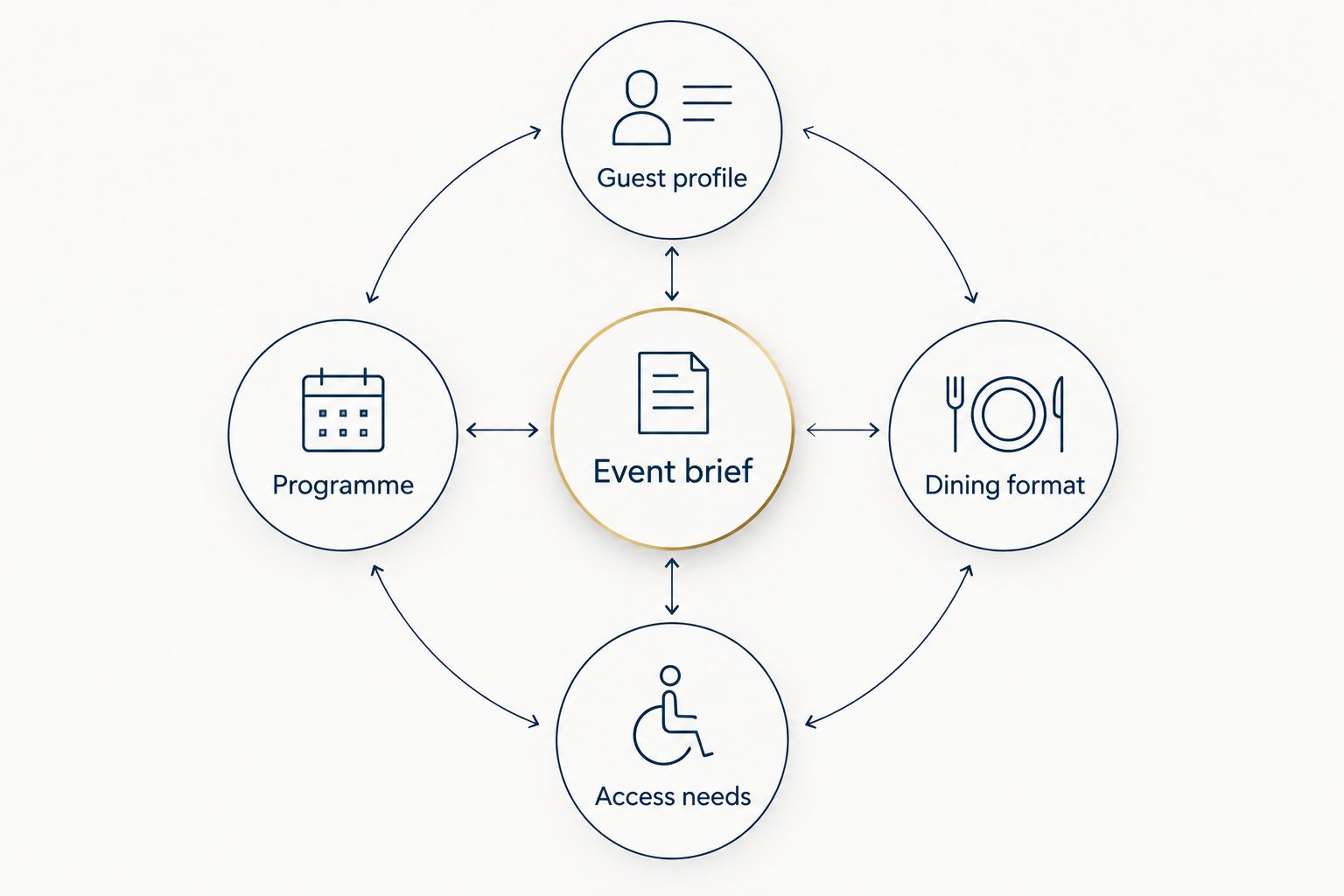
- Guest profile: record the mix of employees, clients, partners and accompanying guests.
- Programme: identify speeches, awards, presentations and moments that need everyone's attention.
- Dining format: specify a seated meal, standing reception or a combination to discuss.
- Access needs: collect mobility requirements and other adjustments privately.
- Event brief: name the decision-maker and define what approval requires.
The brief becomes your filter. Reject a proposal that leaves an essential requirement unresolved, even when the photographs look right.
2. Inspect the venue as a working event space
Review the venue's published information first, then arrange a visit with your brief in hand. Walk the proposed guest route rather than looking only at the dining area. Check the entrance, lifts, reception position, tables and departure point as parts of the same evening.
Ask to see the arrangement proposed for your event, not simply the restaurant's usual layout. Your usable space must account for whatever the programme requires: a welcome point, presentation equipment or room for guests to move between tables.
Nazcaa offers Nikkei dining, cocktails and private event hosting, which makes it relevant to a dining-led shortlist. Confirm the actual event configuration directly, including whether the proposed space and operating arrangements meet your requirements.
- Request 3 layouts for comparison: dining-led, presentation-led and reception-led.
- Check sightlines from the least favourable proposed seats, not just the centre.
- Review 2 routes: the guest arrival route and the service route.
- Ask what changes if outdoor conditions make the proposed arrangement unsuitable.
- Confirm whether other diners or events would share any part of the experience.
3. Build the menu around the programme
Begin with a guest requirements sheet and the order of events. Collect allergies, dietary restrictions and alcohol preferences before discussing individual dishes. Keep sensitive information within the planning team and share only what the venue needs to serve guests appropriately.
Nikkei cuisine brings Japanese and Peruvian influences to the table. For a corporate group, the practical question is how the proposed menu supports a shared occasion: explain unfamiliar dishes clearly and ask how alternatives will be identified and served.
Nazcaa's Nikkei dining is central to its appeal, but your event still needs a menu and service plan agreed for the occasion. Do not assume a restaurant's everyday dining format automatically fits an awards programme or an extended speech.
- Ask the venue to propose a service sequence around the formal programme.
- Confirm how dietary requirements will be recorded, communicated and checked.
- Request clear descriptions of unfamiliar ingredients and preparations.
- Discuss alcoholic and non-alcoholic drinks without assuming a particular package.
- Identify moments when service should pause so attention stays on the speaker.
4. Test speeches, sound and sightlines
Map production needs using a simple programme sheet before hiring equipment. Write down who speaks, where they stand and what guests must see or hear. A short welcome and a presentation with visual material are different technical briefs.
Do not treat a rooftop dining setting as an equipped conference room. Ask which facilities are included, which need an external supplier and which the venue does not permit. Check those answers against the proposed layout, not a generic equipment list.
For a 2026 gala with presentations, plan a technical review before final approval. Speakers need clear sightlines and intelligible sound; service staff need an agreed cue for pauses and transitions.
- Mark the speaking position and check it from every proposed seating zone.
- Test speech audibility with the venue's normal background conditions discussed.
- Confirm power, cable routing and equipment placement with the responsible team.
- Ask about sound restrictions and any approval requirements affecting production.
- Assign a named person to cue speeches, service pauses and transitions.
5. Design arrival and departure with equal care
Write the guest invitation from the perspective of someone visiting the venue for the first time. Include the confirmed venue name, building, level and agreed arrival instructions. Do not substitute a landmark photograph for directions.
At Address Dubai Mall, the level matters as much as the address: the restaurant is on Level 12. Confirm the correct arrival route for your particular event before issuing invitations, including any arrangements for guests who need assistance.
Keep operational details separate from the polished invitation. Drivers, suppliers and speakers need instructions that differ from those sent to dinner guests. Assign responsibility for updating everyone if the plan changes.
- Obtain approved wording for the entrance and lift directions.
- Identify who receives early arrivals and late guests.
- Confirm the assistance process for guests with access requirements.
- Share supplier access instructions only after the venue approves them.
- Give hosts a departure plan covering guest assistance and personal belongings.
6. Close the gaps in the written agreement
Compare proposals against the same brief, then resolve differences before signing. Keep a single decision log so that a menu change, revised layout or production request does not disappear inside an email thread. The final agreement should reflect the event you intend to deliver.
Ask the venue to document scope, responsibilities and conditions in clear language. Private event hosting does not, by itself, establish exclusive use, a particular layout or permission for external equipment. Those details need their own confirmation.
For your 2026 event file, separate confirmed arrangements from open requests. A verbal discussion is not a substitute for an agreed written plan, especially when different teams handle sales, service and production.
- Confirm the precise space, event format and permitted use.
- Record the agreed menu, dietary process and service sequence.
- List included facilities and responsibilities for outside suppliers.
- Document weather arrangements and the decision process for changing the setup.
- Check contractual conditions, change procedures and the final approval deadline.
Compare the setting against the occasion
Choose the format that supports the dominant activity. A dining-led celebration should make conversation and service easy; a presentation-led gala should give the formal programme enough space and attention. Neither requirement disappears because the view is memorable.
Use this comparison to structure venue conversations, not to assume that every property has the same facilities. The strongest proposal is the one that answers your brief in writing.
| Option | Best for | Main advantage | Key limitation to check |
|---|---|---|---|
| Restaurant dining | Corporate hosts prioritising food and conversation | The dining environment is central to the occasion | Confirm flexibility for speeches, equipment and exclusive use |
| Ballroom | Hosts prioritising a formal presentation or awards programme | A dedicated event-room format keeps the programme central | Assess whether the setting delivers the atmosphere you want |
| Standalone terrace | Hosts prioritising an open-air reception | The outdoor setting becomes part of the guest experience | Establish weather arrangements and the dining infrastructure required |
A restaurant is the right starting point when the meal is the event rather than a break between presentations. A ballroom deserves attention when the programme determines the layout. A terrace needs a clear answer to what happens if the outdoor plan changes.
For a 2026 shortlist, keep photographs beside operational notes rather than letting one replace the other. Compare the same requirements across every proposal, including seating, privacy, service, production and access.
Common mistakes corporate gala hosts make
Choosing the view before the programme
A skyline image cannot tell you whether guests will see an award presentation from their seats. Approve the event layout before approving the setting. Ask where the speaker stands and what occupies the space between that position and each table.
Treating a private event as exclusive use
A private event enquiry does not establish that the whole restaurant will be reserved for your organisation. Specify the boundary of the event space and ask which facilities remain shared. That distinction affects privacy, arrival and the atmosphere around speeches.
Making the menu decision without guest requirements
An appealing menu is not yet an event menu. Confirm dietary handling, service order and alternatives alongside the food selection. The host should not be discovering unresolved requirements when guests are already seated.
Adding production after the layout is approved
A screen, speaking position or equipment table changes how a room works. Discuss those needs before approving the seating plan. Otherwise, an arrangement selected for dining can become a compromise once presentation requirements arrive.
Sending invitations before confirming access instructions
A recognisable building name does not explain the correct entrance or route upstairs. Obtain approved arrival wording before invitations leave the organisation. Keep a named host available to resolve guest questions on the day.
FAQ
What's the best gala dinner venue in Dubai for a corporate group?
The best venue is the one that fits your guest requirements, dining format and formal programme. Nazcaa suits a shortlist focused on Nikkei dining, cocktails and a Downtown Dubai skyline setting; confirm the event arrangement directly.
Is a rooftop restaurant better than a ballroom for a corporate gala?
A rooftop restaurant is better suited to a dining-led brief, while a ballroom is an alternative for a programme-led event. Compare the actual layouts, presentation facilities and operating conditions before deciding.
Can a corporate gala dinner include speeches at a restaurant?
Include speeches only after the restaurant confirms a workable sound, seating and service arrangement. Agree where speakers stand and when table service pauses.
What should I ask before booking a rooftop gala dinner?
Ask about the proposed layout, privacy, weather arrangements, dietary handling, production requirements and arrival route. Have the agreed answers included in the written event plan.
Where is Nazcaa located in Dubai?
Nazcaa is on Level 12 of Address Dubai Mall in Downtown Dubai. Obtain the approved arrival instructions for your event before sending guest invitations.
How do I plan a corporate dinner for guests with different dietary needs?
Collect dietary requirements before agreeing the event menu and confirm the handling process with the venue. Ask how alternatives will be identified, communicated to service staff and delivered to the correct guests.
One last thing
Inspect the least impressive seat. Stand where the last arriving guest would sit, then check the speaking position, service route and view from there. A gala should feel considered across the room, not only at the host's table.
Before you approve your 2026 plan, ask the venue to walk through the evening in order: arrival, welcome, dining, formal programme and departure. The transitions reveal what a beautiful photograph leaves out.


